

My name is MAKO
Based in Sapporo, Hokkaido | Born and raised in Obihiro, Hokkaido | Lover of Sapporo Classic beer and fresh sashimi | Passionate about road trips and camping | Always chasing beautiful scenery
Why Are There Sheep at Hitsujigaoka Observation Hill?The Short Answer
The sheep are here because Hitsujigaoka was originally developed as a government livestock research farm in 1906, not as a tourist attraction.
Its wide fields were used to study cattle, pigs, sheep, pasture grasses, and cold-climate farming. Because the land remained agricultural research space even as Sapporo grew around it, this surprisingly rural landscape survived inside a major city.

Why You Should Care
Sapporo is a city of nearly two million people.
Subways.
Office buildings.
Shopping streets.
Apartment towers.
And yet, only a short trip from the center, you can suddenly find sheep grazing on a green hill.
That contrast is exactly what makes Hitsujigaoka Observation Hill interesting.
It looks like someone preserved a small piece of rural Hokkaido inside the city.
But that landscape survived for a reason
Before tourists came here, scientists did.
The Story Behind It
Why Are There Sheep in the Middle of Sapporo?
The story begins in 1906.
The Japanese government established the Tsukisappu Cattle Breeding Farm in this area.
Over time, the site developed into a livestock research center studying cattle, pigs, sheep, pasture plants, animal breeding, and agriculture suited to Hokkaido’s cold climate.
This is why such a large open landscape survived.
As Sapporo expanded outward, much of the city became residential or commercial land.
But Hitsujigaoka continued to be used for agricultural research.
The fields were not empty land waiting to be developed.
They had a job.
Did the Sheep Give Hitsujigaoka Its Name?
The area officially became known as Hitsujigaoka—“Sheep Hill” in 1944.
And yes, sheep became one of the defining images of the landscape.
Even today, grazing sheep remain part of the attraction.
In 2026, outdoor grazing began on April 14 after the snow had melted. The official site notes that sheep may not be released during rain or strong winds for animal-care reasons.
So if seeing sheep is important to you, remember:
They are living animals, not decorations.
Their schedule depends on the season, weather, and their condition.
Why Was Hitsujigaoka Observation Hill Created?
This is where the story becomes a little ironic.
The research farm became too beautiful.
Long before the official observation hill opened, people already knew the area as a scenic place.
After World War II, more and more visitors entered the agricultural research site to enjoy the landscape.
Eventually, the number of tourists became so large that they began interfering with research.
In 1952, the research facility asked for public access to be restricted.
But Sapporo did not want to lose one of its popular views.
City officials, tourism organizations, local authorities, and the research center worked out a solution.
A separate road and designated viewing area would allow tourists to see the hills and grazing sheep without disturbing agricultural research.
On September 18, 1959, Hitsujigaoka Observation Hill officially opened.
So the attraction exists because of a compromise:
protect the research—and protect the view.
Why Does Hitsujigaoka Still Look Like Rural Hokkaido?
Look beyond the tourist area today and you can understand the answer.
Part of the wider Hitsujigaoka landscape is still associated with agricultural research, while other portions are now occupied by the observation hill and the Daiwa House Premist Dome.
Because the area spent more than a century as agricultural and research land, large open fields survived even as urban Sapporo expanded around them.
That gives travelers a rare view:
sheep in the foreground,
green pasture in the middle,
and a major Japanese city beyond.
This is not a recreated theme-park version of Hokkaido countryside.
Its appearance comes directly from the area’s history.
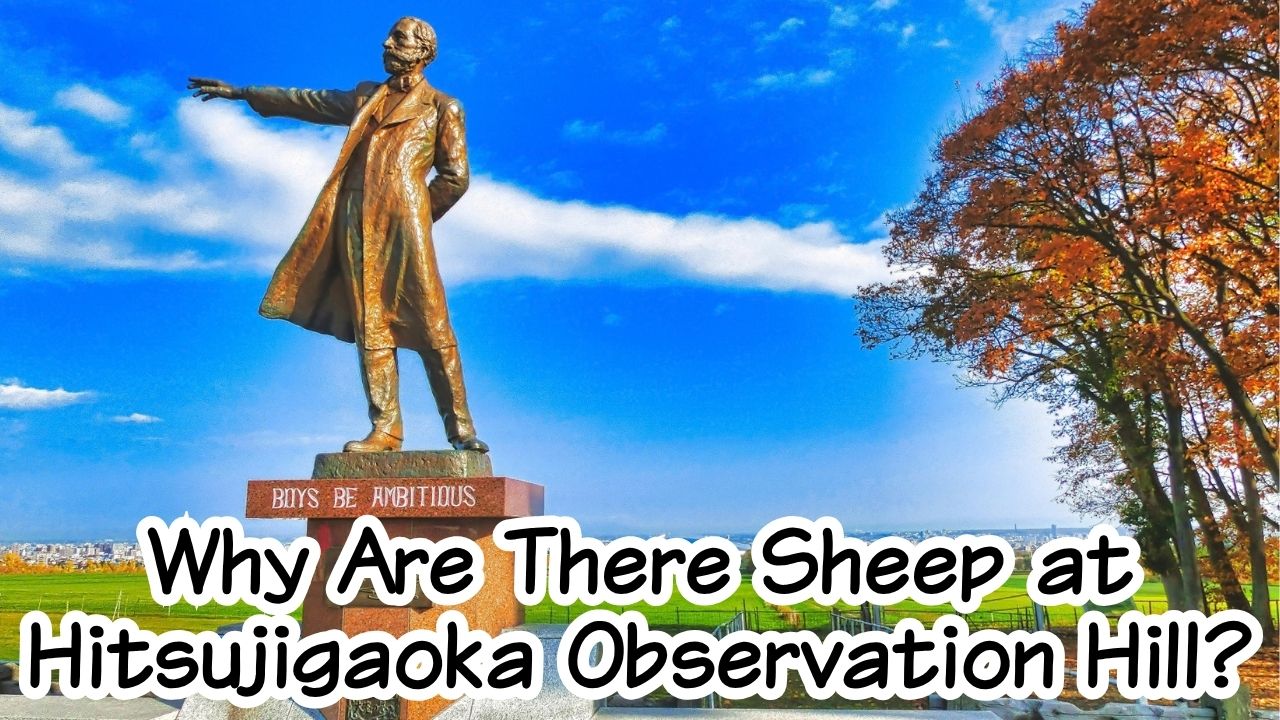
Why Is Dr. Clark Standing at Hitsujigaoka?
For many visitors, Hitsujigaoka means one thing before anything else:
Dr. William S. Clark.
His bronze statue stands with one arm dramatically pointing toward the distance.
But there is a surprising fact.
Clark himself did not make Hitsujigaoka famous.
The statue was not placed here because this was an important location in his life.
The reason is actually tourism.
Why Was the Clark Statue Built Here in 1976?
Dr. Clark was an American educator who served as the first vice president of the Sapporo Agricultural College, the predecessor of Hokkaido University.
His famous phrase,
“Boys, be ambitious!”
became closely associated with Hokkaido.
Originally, visitors went to Hokkaido University to see a bust of Clark.
But so many tourists—and especially sightseeing buses—entered the university grounds that they began disturbing research and education.
In 1973, Hokkaido University restricted tourist bus access.
Sound familiar?
Hitsujigaoka had faced almost the same problem years earlier.
So the Sapporo Tourism Association planned a new Clark statue at Hitsujigaoka.
The full-body bronze statue was completed in 1976, exactly 100 years after Clark arrived in Hokkaido.
In a strange way, both the observation hill and its most famous statue exist because:
too many tourists wanted to see something.
What Is Dr. Clark Pointing At?
Visitors often assume he is pointing toward Sapporo.
The official Hitsujigaoka explanation gives the pose a more symbolic meaning.
His raised right hand points toward “eternal truth in the far distance,” expressing the idea of looking toward the future with ambition.
That is why so many visitors stand next to him, copy his pose, and take a photograph.
You can also write a personal dream or goal on a “Vow of Ambition” card and place it in a box inside the statue’s base.
The tourism association keeps the card, and if you return someday, you can ask to see what you wrote during your earlier visit. The current storage fee is ¥100
That turns a sightseeing photo into something a little more personal.
What Can You Actually See From Hitsujigaoka?
The view is wider than many first-time visitors expect.
From the hill, you can see across the open fields toward Sapporo and the Ishikari Plain.
The large Daiwa House Premist Dome is one of the easiest landmarks to recognize. On clear days, the view can extend much farther across the plain.
It is the contrast that makes the scene special:
sheep + grassland + dome + city
all in one frame.
Few places show both sides of Sapporo so clearly.
When Can You See the Sheep Grazing?
For the classic green-field view, the warmer months are best.
The official site explains that the sheep are generally grazed from spring after the snow melts until before snowfall.
They stay in their shelter during winter and may also remain inside during rain or strong winds.
In 2026, grazing began on April 14.
That means late spring through autumn is usually the best choice if your main goal is:
“I want that famous Hokkaido photo with sheep.”
Winter, however, offers a completely different experience.
The fields become a huge white landscape.
Why Is Hitsujigaoka Also Connected to the Sapporo Snow Festival?
There is another small museum here that travelers sometimes overlook:
the Sapporo Snow Festival Museum.
It presents the history of the famous festival through photographs, panels, and models of past snow sculptures.
This makes Hitsujigaoka more than a scenic stop.
In one visit, you can connect several pieces of Sapporo’s identity:
agriculture,
Clark,
sheep,
snow,
and the growth of the modern city.
Is Hitsujigaoka Observation Hill Changing Soon?
Yes—and this is especially important for anyone planning a future trip.
The official site announced that Hitsujigaoka Observation Hill will close for facility renovations beginning April 1, 2027.
Its final operating day before the closure is scheduled to be March 31, 2027.
As of October 2026, the official announcement does not give a reopening date.
So travelers planning to visit from April 2027 onward should not assume the attraction will be open.
Please check the official website for the latest information.
Why Is There a Statue of Dr. Clark at Hitsujigaoka Observation Hill?
One of the most famous landmarks at Hitsujigaoka Observation Hill is the statue of Dr. William Smith Clark, known for his legendary words:
“Boys, be ambitious!”
But here’s something surprising: Dr. Clark had no direct historical connection to Hitsujigaoka Observation Hill!
So why was his statue built here?
Why Was Dr. Clark’s Statue Built Here in 1976?
Dr. Clark was an influential educator at Sapporo Agricultural College, now Hokkaido University.
Originally, visitors came to Hokkaido University’s campus to see his famous bust. However, as tourism increased, large numbers of visitors began disrupting the university’s academic environment.
To solve this problem, a new full-body statue was unveiled at Hitsujigaoka Observation Hill on April 16, 1976.
The statue was created to celebrate Dr. Clark’s legacy and share his pioneering spirit with visitors from across Japan.
What Does Dr. Clark’s Raised Right Hand Mean?
Have you ever wondered why Dr. Clark is pointing toward the sky?
His raised right hand symbolizes “the eternal truth far beyond the horizon.”
The pose represents his famous message, “Boys, be ambitious,” encouraging people to pursue their dreams and aim for something greater.
What Is the “Oath of Ambition”?
Here’s another unique experience you shouldn’t miss!
At the base of Dr. Clark’s statue, you’ll find a special mailbox for the “Oath of Ambition” (Taishi no Chikai).
Visitors can write down their dreams and goals on a special form and place it inside the mailbox.
The wonderful part? Your written promise will be carefully preserved by the Sapporo Tourist Association!
If you return to Hitsujigaoka Observation Hill years later, you can even ask to see the promise you made to yourself.
It’s a beautiful way to turn your visit into a lasting memory.
Did You Know?
- Hitsujigaoka began as a government livestock research farm in 1906.
- Public access was restricted in 1952 because too many visitors were interfering with agricultural research.
- Hitsujigaoka Observation Hill officially opened in 1959.
- The famous Clark statue was installed in 1976, not during Clark’s lifetime.
- The attraction is scheduled to close for renovations from April 1, 2027.
FAQ
Are There Always Sheep at Hitsujigaoka Observation Hill?
Sheep live at the facility, but they are not always outdoors.
They are generally grazed during the warmer months and stay indoors during winter, rain, or strong winds.
Did Dr. Clark Actually Live at Hitsujigaoka?
Hitsujigaoka is famous for his statue, but the statue was created as a tourism symbol in 1976.
It was installed after tourist congestion around the Clark bust at Hokkaido University became a problem.
What Is “Boys, Be Ambitious”?
It is the famous phrase traditionally associated with Dr. William S. Clark and his time in Hokkaido.
Today, it has become one of Hokkaido’s best-known expressions of ambition and frontier spirit.
Is Hitsujigaoka Good in Winter?
Yes, but the experience is different.
You will not normally see sheep grazing outside, but the snowy hill creates a very Hokkaido-like winter landscape.
Will Hitsujigaoka Be Open in 2027?
It is scheduled to operate through March 31, 2027, then close for renovations from April 1, 2027.
A reopening date has not yet been announced as of October 2026.
Visit It Yourself
Location
Sapporo Hitsujigaoka Observation Hill
Hitsujigaoka 1, Toyohira-ku, Sapporo, Hokkaido.
Best Season
For sheep grazing and green scenery:
Late spring through autumn
July can also bring lavender scenery.
For snow landscapes:
Winter
Remember that the sheep are generally not grazed outdoors during winter or severe weather.
How to Get There
From central Sapporo:
Take the Toho Subway Line to Fukuzumi Station.
From Fukuzumi Bus Terminal, take the Fuku 84 Hitsujigaoka Line.
The bus ride from Fukuzumi takes about 10–12 minutes.
Estimated Visit Time
1–2 hours
Allow extra time if you plan to eat jingisukan, visit the museums, or join seasonal activities.
Admission Fee
As of October 2026:
Adults: ¥1,000
Elementary and junior high school students: ¥500
Preschool children: Free
Opening Hours
October–May: 9:00 a.m.–5:00 p.m.
June–September: 9:00 a.m.–6:00 p.m.
Final admission is 15 minutes before closing.
Important 2027 Closure
Hitsujigaoka Observation Hill is scheduled to close for renovations from April 1, 2027.
The final operating day before the closure is scheduled for March 31, 2027.
Please check the official website for the latest information.
Official Website
Sapporo Hitsujigaoka Observation Hill Official Website
Final Thoughts
Why are there sheep at Hitsujigaoka Observation Hill?
Because this hill was never originally created for tourists.
It was created for agriculture.
Researchers needed wide fields.
They studied livestock.
They studied pasture.
Sheep grazed here.
Then Sapporo grew.
Homes and roads spread across the city.
But these agricultural fields remained.
People discovered the view.
Too many visitors came.
So a special observation area was created.
Years later, the same kind of tourist problem at Hokkaido University led to a new Clark statue being built here.
That is how everything came together:
sheep, science, tourism, Dr. Clark, and Sapporo.
When you stand beside the famous statue, do not only photograph Clark.
Turn around.
Look at the sheep.
Then look beyond them at the city.
That contrast tells the real story.
Hitsujigaoka looks like old rural Hokkaido because its history protected that landscape while modern Sapporo grew around it.








コメント