

My name is MAKO
Based in Sapporo, Hokkaido | Born and raised in Obihiro, Hokkaido | Lover of Sapporo Classic beer and fresh sashimi | Passionate about road trips and camping | Always chasing beautiful scenery
Why Does Obihiro Have Moor Hot Springs?The Short Answer
Deep beneath the Tokachi Plain lie layers formed from ancient plant material. Groundwater passes through these organic-rich layers, picks up plant-derived substances, and is heated underground before being pumped to the surface.
That is why Obihiro has moor hot springs—often amber or brown in color—even though the city sits in the middle of a broad plain rather than beside a dramatic volcanic mountain.

Why You Should Care
Obihiro does not look like a classic Japanese hot-spring town.
There are no steep volcanic valleys filled with steam. There is no traditional onsen street lined with ryokan.
Instead, you can find real hot springs in ordinary public bathhouses and city hotels.
Obihiro City itself notes that being able to enjoy genuine hot springs in a normal urban area—not a traditional hot-spring resort—is unusual in Japan.
That means a bath in Obihiro is more than relaxation.
It is a chance to experience what is hidden deep beneath the Tokachi Plain.
The Story Behind It
What Is a Moor Hot Spring?
First, “moor” does not mean moss.
The name comes from the German word Moor, associated with peat and traditional peat bathing.
In Tokachi, ancient reeds and other plants accumulated over a very long period. These plant remains eventually formed peat- and lignite-rich layers underground.
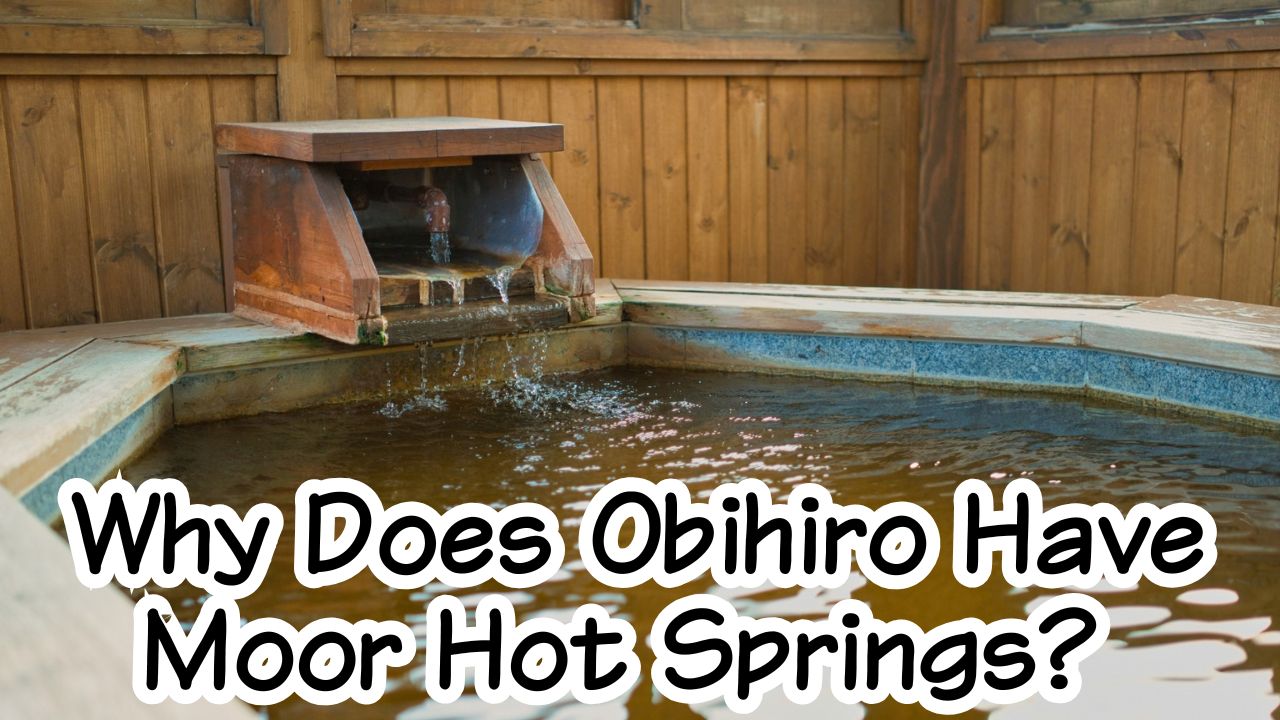
As groundwater passes through these layers, it picks up organic substances, including humic materials. This gives many moor hot springs their distinctive transparent brown or amber color.
There is another interesting detail.
“Moor hot spring” is not an official water-quality category under Japan’s Hot Spring Law.
Depending on its mineral composition, a moor spring may officially be classified as an alkaline simple spring, sodium chloride spring, or bicarbonate spring. “Moor” describes its plant-derived character.
Why Does Moor Hot Spring Water Rise Beneath Obihiro?
The answer is hidden far below the city.
According to the Tokachigawa Onsen Tourism Association, hot spring water in central parts of the Tokachi Plain, including Obihiro, can be drawn from depths of more than 1,000 meters, with temperatures around 50°C.
Deep underground, groundwater moves through organic-rich geological layers and is warmed by geothermal heat.
So you do not need a volcano standing beside the bath.
The huge sedimentary basin beneath the Tokachi Plain works like a natural underground system for storing and heating water.
That is why a traveler can be walking through downtown Obihiro one moment—
and soaking in natural hot spring water the next.
Why Is Moor Hot Spring Water Brown?
The color comes from substances picked up underground.
Obihiro tourism information explains that the water contains plant-derived organic materials such as humic and fulvic acids.
Depending on the spring and lighting, the water may look:
- light tea-colored
- amber
- reddish brown
- almost black in deeper baths
The texture is also often described locally as smooth or silky.
Because of this, Tokachi’s moor hot springs are often marketed as “bijin no yu,” or “beauty hot springs.” Local official sources describe moisturizing and smoothing effects, although visitors should think of this primarily as a regional onsen tradition rather than a medical treatment.
Why Can You Find Hot Springs in Ordinary Obihiro Bathhouses?
This may be the most surprising part of the story.
In many parts of Japan, you travel to a special hot-spring resort to enjoy natural onsen.
In Obihiro, hot spring water is part of everyday city life.
The city explains that natural hot springs flow at public bathhouses around Obihiro, while hotels with large baths also tap hot spring sources.
So locals do not always treat moor onsen as a luxury vacation experience.
Sometimes it is simply where you go for a bath.
That gives Obihiro a very different kind of onsen culture from famous mountain resorts such as Noboribetsu.
The hot spring is not separated from the city. It is woven into daily life.
How Is Obihiro Connected to Tokachigawa Onsen?
Obihiro is not the only place in the area famous for moor springs.
About 10 kilometers northeast of central Obihiro is Tokachigawa Onsen, in Otofuke Town.
There, moor hot spring water rises closer to the surface. The local tourism association says sources around Tokachigawa Onsen are commonly found around 500–700 meters underground and can reach roughly 55–60°C.
Tokachigawa developed into a traditional resort area, while Obihiro developed into a city where hot springs became part of hotels and neighborhood bathhouses.
The two experiences complement each other.
Stay in Tokachigawa if you want a full onsen-resort atmosphere.
Stay in Obihiro if you want to discover how natural hot springs fit into an ordinary Hokkaido city.
Why Is Moor Onsen a Hokkaido Heritage?
Moor hot springs were selected as a Hokkaido Heritage in 2004.
Hokkaido Heritage is a regional program created to preserve and pass on important natural, cultural, historical, and industrial assets to future generations.
The designation reflects more than the color of the water.
Moor springs are connected to:
- the geology of the Tokachi Plain
- ancient plant deposits
- local bathing culture
- tourism
- everyday life in communities such as Obihiro and Otofuke
So when you take a bath here, you are experiencing something that locals consider part of Hokkaido’s heritage.
Did You Know?
- Moor hot spring water gets its distinctive color partly from plant-derived humic substances.
- Hot spring water beneath central Obihiro can come from more than 1,000 meters underground.
- “Moor hot spring” is not an official Japanese legal spring classification.
- You can enjoy natural hot springs in ordinary public baths in Obihiro, not only at resort hotels.
- Moor hot springs became a Hokkaido Heritage in 2004.
FAQ
Is Moor Hot Spring Water Dirty Because It Is Brown?
No.
The brown or amber color comes from naturally occurring organic substances picked up as groundwater passes through plant-rich underground layers.
Is Tokachigawa Onsen the Same as Obihiro?
No.
Tokachigawa Onsen is in neighboring Otofuke Town, while Obihiro is a separate city.
However, both are part of the Tokachi region and share the same broader moor-hot-spring story.
Do I Need to Stay at a Ryokan to Try Moor Onsen?
No.
Obihiro has hotels and public bathhouses where visitors can enjoy natural hot spring water without staying overnight.
Can I Enjoy Moor Hot Springs in Winter?
Yes.
They can be enjoyed year-round, and winter is especially atmospheric when steam rises into the cold Hokkaido air.
Visit It Yourself
Location
One convenient place for travelers to experience moor hot spring water in Obihiro is 北海道ホテル モール温泉・サウナ.
Address: Nishi 7-jo Minami 19-chome, Obihiro
Best Season
Year-round
Winter is especially memorable, but an urban moor-onzen bath feels good after sightseeing in any season.
How to Get There
The hotel is about a 5-minute drive from JR Obihiro Station.
Estimated Visit Time
1–2 hours
Day-Use Admission
As of September 2026:
- Adult: ¥2,000
- Elementary school age and younger: ¥500
- Towels are included.
Day-Use Hours
- Morning: 5:30 a.m.–9:00 a.m. last entry
- Afternoon/evening: 2:00 p.m.–9:00 p.m. last entry
Availability may be limited during busy periods.
Please check the official website for the latest information.
Official Website
Forest Spa Resort Hokkaido Hotel
Final Thoughts
Why does Obihiro have moor hot springs?
Because the story begins long before Obihiro became a city.
Plants grew across the ancient Tokachi landscape.
They died.
They accumulated underground.
Over enormous stretches of time, they became organic-rich layers beneath the plain.
Groundwater passed through them.
Heat from deep underground warmed the water.
And eventually, people drilled down and brought that water back to the surface.
Today, you can finish dinner near Obihiro Station, walk into a hotel or neighborhood bathhouse, and soak in amber-colored water that carries traces of that underground history.
That is what makes Obihiro’s onsen culture so interesting.
You do not have to leave the city to discover the ancient Tokachi Plain beneath your feet.








コメント