
My name is MAKO
Based in Sapporo, Hokkaido | Born and raised in Obihiro, Hokkaido | Lover of Sapporo Classic beer and fresh sashimi | Passionate about road trips and camping | Always chasing beautiful scenery
The Short Answer
Tomakomai is famous for hokki clams because its sandy Pacific coast provides excellent fishing grounds, and generations of local fishermen have carefully managed the resource.
After hokki stocks once became dangerously low, fishermen introduced strict catch controls and other conservation efforts. Today, hokki is not only one of Tomakomai’s main fisheries—it has become part of the city’s identity and everyday food culture.

Why You Should Care
Hokkaido has many famous seafood destinations.
So why should you remember Tomakomai?
Because its hokki story shows that great seafood is not only about having a rich ocean.
It is also about people deciding to protect what the ocean gives them.
And when you sit down to eat hokki curry or fresh hokki sashimi in Tomakomai, you are tasting something that local fishermen, families, and even schoolchildren have made part of the city’s culture.
That makes a simple clam much more interesting.
The Story Behind It
Why Does Tomakomai Have Such Good Hokki Clam Fishing Grounds?
Tomakomai faces the Pacific Ocean on Hokkaido’s southern-central coast.
Its coastline has long stretches of sandy seabed—exactly the kind of environment where hokki clams live buried beneath the sand.
There is another important feature.
Waters influenced by the Oyashio Current, Tsugaru Warm Current, and coastal waters meet around this area, helping create productive fishing grounds.
Hokki clams live in shallow sandy and muddy seabeds and can grow to more than 10 centimeters across. Their official Japanese name is ubagai, although almost everyone in Hokkaido calls them hokki or hokkigai.
The sea gave Tomakomai the right environment.
But nature alone does not explain its success.
Tomakomai Almost Lost Its Hokki Clams
Here is the part of the story many travelers do not know.
Tomakomai’s hokki stocks were not always abundant.
According to the city, the resource once fell to such a low level that maintaining the fishery became difficult. Fishermen responded by bringing in young clams from other parts of Hokkaido and voluntarily limiting their catches.
Instead of thinking only about the next catch, they began thinking about the future.
The basic idea was simple:
If we want to keep catching hokki tomorrow, we cannot take everything today.
Over time, those efforts helped the resource recover.
And eventually, Tomakomai became Japan’s leading city for hokki catches.
That makes the city’s No. 1 ranking much more meaningful.
Why Are Tomakomai Hokki Clams So Carefully Protected?
Even today, fishermen cannot simply harvest every clam they find.
Hokkaido prohibits harvesting smaller hokki clams, but Tomakomai goes further.
The Tomakomai fishing cooperative only lands clams with shells measuring 9 centimeters or more. The city also closes the fishery during the May–June spawning period.
Before fishing begins, surveys are carried out to estimate the amount of hokki in the fishing grounds. Catch limits are then decided based on the condition of the resource.
This means a large Tomakomai hokki clam is not simply the result of growing in the ocean.
It is also the result of fishermen waiting.
How Do Fishermen Catch Hokki Clams Under the Sand?
Hokki clams spend their lives buried beneath the seabed.
So how do fishermen find them?
Tomakomai uses a special type of fishing gear called a hydraulic dredge.
High-pressure seawater is directed toward the seabed, gently digging into the sand and bringing buried clams into a net. The catch is then brought onto the boat and sorted by species, size, and condition.
It is not the kind of fishing most travelers imagine when they picture a fishing boat.
The real treasure is hidden under the sand.
Why Do Tomakomai Hokki Clams Taste So Good?
Hokki has a very different texture from oysters or scallops.
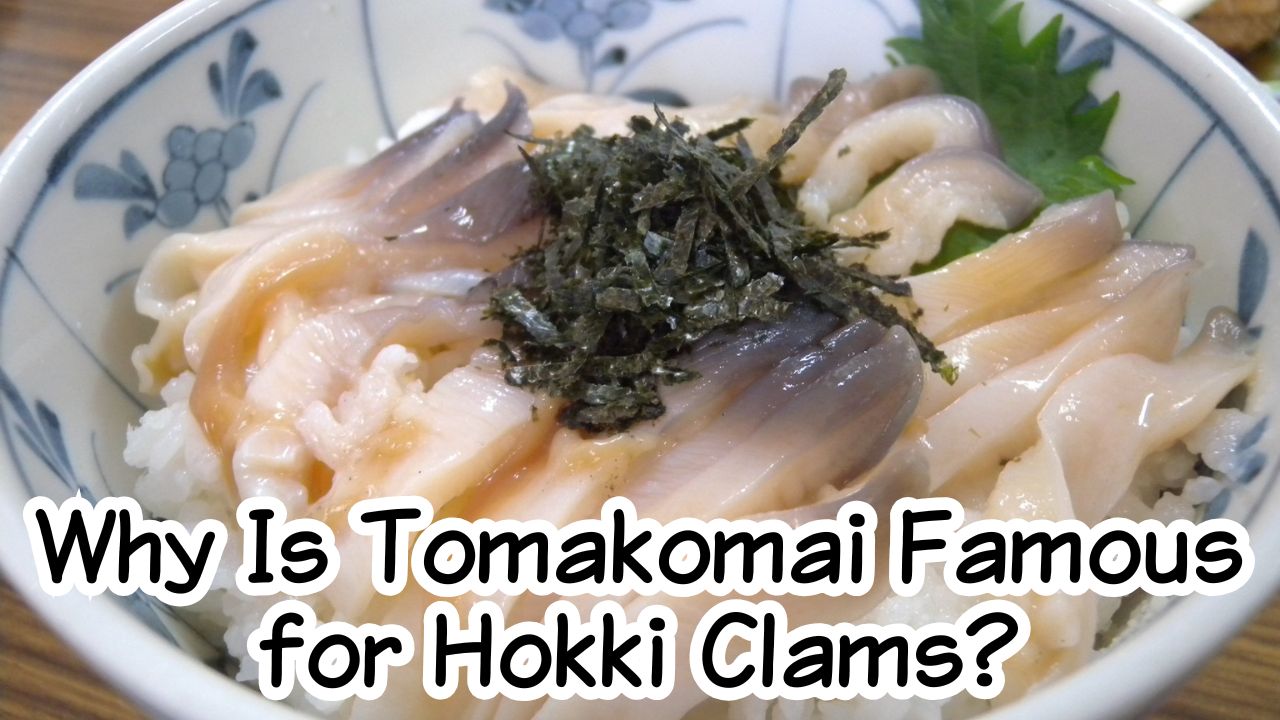
The meat is firm and pleasantly chewy, with a gentle sweetness and rich seafood flavor.
Tomakomai City notes that hokki contains the flavor-related amino acids glycine and alanine, both associated with sweetness.
It can also surprise first-time visitors with its color.
Raw hokki meat is relatively pale, but when heated, part of it turns a beautiful reddish-pink.
That is why cooked hokki looks so colorful in sushi, rice dishes, and curry.
Hokki Curry Shows That This Is Not Just Tourist Food
Perhaps the best proof that hokki belongs to Tomakomai is hokki curry.
This was not simply invented as a clever dish for tourists.
Tomakomai City says hokki curry and hokki mixed rice have long been prepared in local homes. Hokki dishes are also served in local restaurants and even appear in school lunches.
That changes how you should think about the dish.
Hokki curry is not just:
“Curry with an unusual seafood topping.”
It is a local family dish created in a city where fresh hokki was part of everyday life.
Other local preparations include sashimi, sushi, butter-grilled hokki, rice dishes, fried hokki, and more.
How Did Hokki Become a Symbol of Tomakomai?
By the early 2000s, hokki was already much more than another seafood product.
It supported the fishing industry, appeared in local homes and schools, and helped represent Tomakomai outside the city.
So on July 20, 2002—Marine Day—Tomakomai officially designated hokki as the “Shell of the City.”
Today, the city catches around 800 tons a year, and the latest municipal figures show 25 consecutive years as Japan’s top municipality for hokki catches through 2024.
But perhaps the better achievement is not simply being No. 1.
It is becoming No. 1 after learning how important it was to protect the resource.
That is the real story behind Tomakomai’s hokki clams.
How to Enjoy Tomakomai Hokki Clams
Try More Than One Style
If this is your first time eating hokki, do not stop with one preparation.
Try it in a few different ways:
- Sashimi or sushi to enjoy its firm texture and natural sweetness
- Hokki curry for one of Tomakomai’s classic local dishes
- Hokki rice for a gentler, comforting seafood flavor
- Grilled or butter-cooked hokki to enjoy its aroma and reddish color
The same clam can taste surprisingly different depending on how it is prepared.
For travelers, that is part of the fun.
Try Marutoma Shokudo’s Famous Hokki Curry
If you’re looking for a unique way to enjoy hokki clams, don’t miss the famous Hokki Curry at Marutoma Shokudo.
Located next to Tomakomai Fish Market, this local restaurant is famous for its generous portions of fresh seafood. The rich Japanese curry is topped with tender hokki clams, creating a delicious combination that’s loved by both locals and visitors. Be prepared to arrive early, as it’s one of the city’s most popular restaurants. (marutoma-shokudo.com)
Address
1-1-13 Shiomicho, Tomakomai, Hokkaido(Tomakomai Public Wholesale Market 1F)
Did You Know?
- The formal Japanese name for hokki clam is ubagai.
- Tomakomai was Japan’s No. 1 municipality for hokki clam catches for 25 consecutive years from 2000 to 2024.
- Only clams measuring 9 cm or larger are landed under Tomakomai’s local rules.
- Fishing stops during the May–June spawning season to help protect the resource.
- Hokki has officially been the “Shell of Tomakomai City” since 2002.
FAQ
What Is Hokki Clam in English?
Hokki is usually called Japanese surf clam or Sakhalin surf clam in English.
Its scientific name is Pseudocardium sachalinense.
What Does Hokki Clam Taste Like?
It has a slightly sweet seafood flavor with a firm, pleasantly chewy texture.
The texture is quite different from softer shellfish such as oysters.
Is Hokki Clam Eaten Raw?
Yes.
Fresh hokki is commonly eaten as sashimi or sushi, but it is also excellent cooked in rice dishes, curry, grilled dishes, and other recipes.
When Can I Eat Fresh Tomakomai Hokki?
Tomakomai stops fishing during the May–June spawning period. Local hokki is harvested during other parts of the year, although restaurant availability can vary.
Please check the official website for the latest information.
Why Is Tomakomai No. 1 for Hokki Clams?
The city has productive sandy fishing grounds, but careful management is also important.
Fishermen survey stocks, limit catches, protect smaller clams, and close the fishery during spawning season.
Visit It Yourself
Location
Tomakomai, Hokkaido — on the Pacific coast south of New Chitose Airport
Best Season
July to April if your priority is locally harvested Tomakomai hokki. Fishing is closed during the May–June spawning period.
How to Get There
From New Chitose Airport, JR trains reach Tomakomai in about 30 minutes with a transfer at Minami-Chitose. Direct local buses to Tomakomai are also available.
Estimated Visit Time
Allow 2–3 hours for a relaxed seafood lunch and a walk around the port area.
A half day gives you more time to explore Tomakomai.
Admission Fee
None to visit the city or port area. Food prices vary by restaurant.
Official Information
Please check the official website for the latest information.
Final Thoughts
At first, Tomakomai’s claim to fame sounds simple:
Japan’s No. 1 city for hokki clams.
But now you know there is much more behind that number.
There is a sandy Pacific seabed.
Different ocean waters meeting off the coast.
There was a time when the hokki resource became dangerously low.
And there were fishermen who decided that protecting tomorrow’s catch was more important than taking everything today.
Their efforts helped the resource return.
Then hokki moved beyond the fishing port and into family kitchens, curry, school lunches, and the identity of the city itself.
So when you visit Tomakomai and take your first bite of hokki, remember:
You are not simply eating one of Hokkaido’s famous shellfish.
You are tasting a seafood culture that a city chose to protect.
That is why Tomakomai deserves to be called Hokkaido’s surf clam capital.






コメント