

My name is MAKO
Based in Sapporo, Hokkaido | Born and raised in Obihiro, Hokkaido | Lover of Sapporo Classic beer and fresh sashimi | Passionate about road trips and camping | Always chasing beautiful scenery
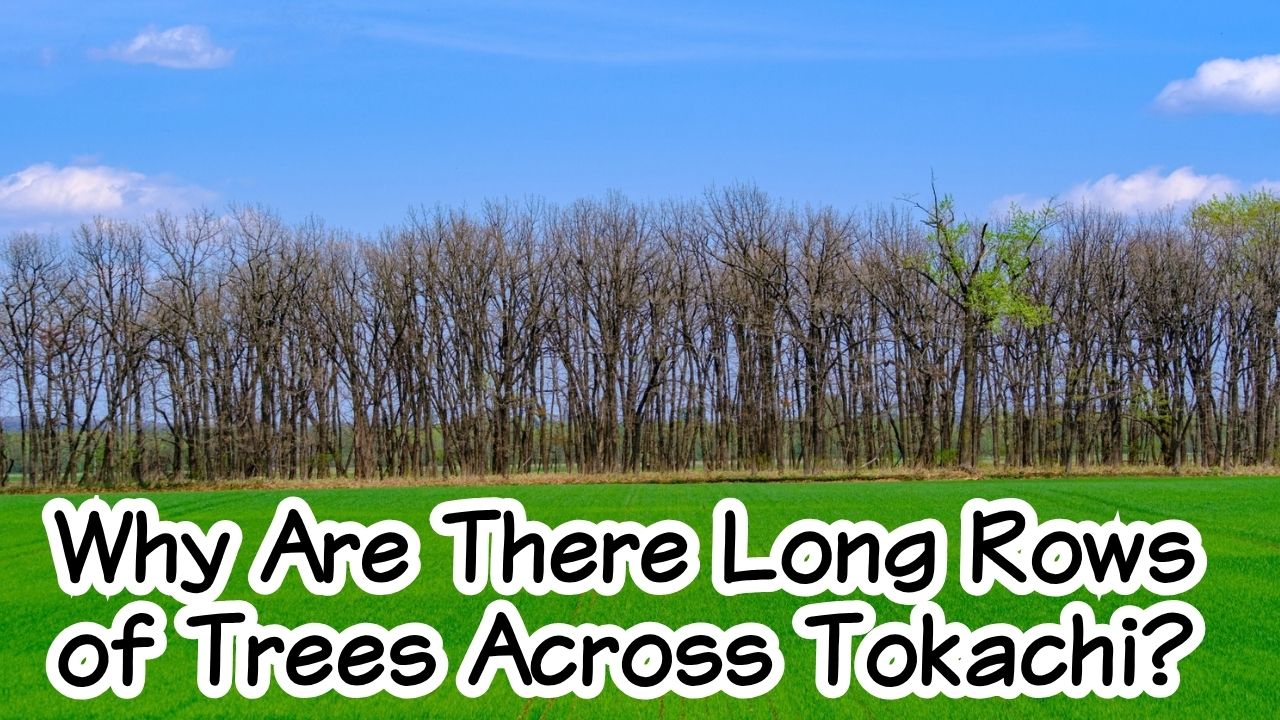
Why Are There Long Rows of Trees Across Tokachi?The Short Answer
Those long rows of trees are windbreak forests, planted to protect Tokachi’s huge farm fields from strong winds.
They reduce wind speed, help prevent crops from being damaged, keep valuable topsoil from blowing away, and protect field temperatures. Over time, something planted for practical reasons also became one of Tokachi’s most beautiful landscapes.

Why You Should Care
Drive across Tokachi and you will notice something strange.
The fields seem endless.
Then, suddenly, a perfectly straight wall of trees crosses the landscape.
Drive farther, and another appears.
And another.
From the air, the farmland can look almost like a giant patchwork quilt stitched together with forests.
It is beautiful.
But the trees were not planted to make Tokachi beautiful.
They were planted to make farming possible.
Once you know that, those ordinary rows of trees become part of the story of how people learned to farm one of Hokkaido’s largest agricultural regions.
The Story Behind Tokachi’s Windbreak Forests
Why Does Tokachi Need Windbreak Forests?
Tokachi is famous for its huge, open farmland.
But wide-open land also has a weakness:
there is little to stop the wind.
Strong winds can damage young crops, lower temperatures near the ground, dry the soil, and blow away the valuable surface layer of farmland.
Windbreak forests work like a giant natural wall.
They do not completely stop the wind.
Instead, the trunks, branches, and leaves break up the airflow and reduce its speed before it reaches the fields. The Hokkaido Government identifies protection against crop damage, falling soil temperature, and topsoil loss as key functions of these forests.
Do a Few Rows of Trees Really Make That Much Difference?
Surprisingly, yes.
Researchers in Tokachi studied a windbreak made from only two rows of larch trees about 20 meters tall.
On the downwind side, wind speed was reduced by more than 20% at distances two to eight times the height of the trees.
At a distance four times the tree height, the reduction reached about 33%.
That is not just a theory.
After Typhoon No. 18 passed through Hokkaido in 2017, researchers compared cornfields on opposite sides of windbreak forests in places such as Shihoro and Shintoku.
Corn on the exposed side had largely fallen over.
On the protected side, the damage was much smaller.
A quiet row of trees can make a very real difference to a farmer.
When Did Tokachi’s Windbreak Forests Begin?
Their story is closely connected with Hokkaido’s modern settlement and agricultural development.
In May 1896, rules known as the Shokuminchi Sentei oyobi Kukaku Shisetsu Kitei were established.
Under these rules, major windbreak forests were incorporated into the planned development of new agricultural land.
As more land was cleared for farming, towns and agricultural organizations also encouraged farmers to plant smaller windbreaks around cultivated fields.
Some provided support for seedlings and planting costs.
By the 1930s and early 1940s, the landscape that resembles today’s network of farm windbreaks had largely taken shape.
The straight forests you see today are therefore not random pieces of woodland.
They are part of the design of modern agricultural Tokachi.
Why Are Tokachi’s Fields So Geometric?
The trees are only half of the pattern.
The fields themselves were carefully planned.
In the late 19th century, agricultural settlement projects divided land into large square sections measuring 300 ken, or about 546 meters, on each side.
Those large blocks were then divided into smaller farm lots.
Windbreak forests were placed around and between these agricultural areas.
That is why an aerial view of Tokachi looks so geometric:
rectangular fields,
straight roads,
and long forests crossing them like lines on graph paper.
This landscape may look completely natural from a distance.
In reality, it records the history of how the land was organized for agriculture.
Why Is Tokachi Famous for Agriculture?
Tokachi’s beautiful geometric fields are more than just scenery—they’re part of one of Japan’s most important agricultural regions!
But why did Tokachi become such a major farming area?
Discover the fascinating story behind Hokkaido’s agricultural heartland.
Read next: Why Is Tokachi Famous for Agriculture? The Story Behind Hokkaido’s Farming Heartland
Were Windbreak Forests Only Used to Stop Wind?
No.
During the early settlement period, forests also had practical value as a source of fuel wood.
Japan’s Ministry of Agriculture, Forestry and Fisheries notes that Tokachi’s windbreak forests were maintained not only to protect farmland from strong winds from the Hidaka Mountains, but also to help meet settlers’ fuel needs.
Later, their roles expanded.
Today they also contribute to:
- rural scenery
- wildlife habitat
- ecological connections between wooded areas
- protection of living environments
The Hokkaido Government specifically notes that animals such as the Ezo red squirrel use these forests as valuable habitat.
What began as agricultural infrastructure gradually became part of an ecosystem.
Why Are Larch Trees So Common?
When you drive through Tokachi, many windbreaks have tall, narrow trees that lose their needles in winter.
These are often Japanese larch.
Larch has long been widely planted in Hokkaido and is well suited to the region’s cold conditions.
Its tall form also makes it useful for creating long windbreak belts without requiring extremely wide forests.
Research in Tokachi has shown that even a narrow two-row larch windbreak can significantly reduce wind speed over the field behind it.
So those elegant tree lines are beautiful—but their shape is also functional.
Why Is the 10-Sen Windbreak Forest in Memuro Special?
If you want to see one impressive example, look toward Memuro, west of Obihiro.
The 10-Sen Windbreak Forest stretches from the Shinsei area toward Kami-Fushiko.
According to Memuro Town, it is about 9.2 kilometers long and roughly 65 meters wide. It was designated as a national wind protection forest in 1922 and was selected as one of the town’s “Memuro Heritage” sites in 2006.
Local tourism information promotes it as one of Japan’s longest windbreak forests.
When you drive beside it, the trees seem to continue almost endlessly.
But remember:
this giant green line is not a decorative avenue.
It has spent more than a century helping protect Tokachi agriculture.
Why Do Windbreak Forests Make Tokachi Look So Beautiful?
This is one of the nicest accidents in Hokkaido’s landscape.
People planted the trees because they needed protection from the wind.
But when those forests were combined with Tokachi’s enormous rectangular fields, they created one of Hokkaido’s most recognizable rural views.
Spring brings fresh green leaves.
Summer creates deep green walls between crop fields.
Autumn adds yellow and orange.
In winter, dark rows of trunks cross a white landscape.
Japan’s Ministry of Agriculture now highlights the combination of Tokachi’s geometric farmland and windbreak forests as an important agricultural landscape.
A practical solution became a beautiful view.
Are Tokachi’s Windbreak Forests Disappearing?
Some are.
Modern Tokachi agriculture has changed dramatically.
Farms have become larger.
Tractors and other agricultural machines have become bigger.
GPS and automated farming technologies are increasingly important.
For farmers, trees can also create disadvantages.
Branches and leaves fall into fields.
Shade can reduce crop growth close to the trees.
And narrow spaces beside forests can make large machinery harder to operate.
The Hokkaido Government says that some farm windbreaks are now being cut down and not replanted, raising concern about their long-term decline.
A regional survey also found that farmers understand many of the benefits, while some struggle with these practical disadvantages.
Is Tokachi Trying to Protect Its Windbreak Forests?
Yes.
Since 2021, the Tokachi General Subprefectural Bureau has been working with agricultural and forestry organizations to better understand why windbreaks are disappearing and how they might be maintained.
A special Tokachi farm-windbreak project team was formed in 2022.
Local high school students have also joined awareness programs and tree-planting projects. In 2023, students from Shihoro High School helped plant new windbreak trees on a local farm, with follow-up care continuing afterward.
The goal is not simply:
“Keep every tree exactly as it is.”
Modern farming needs to remain efficient.
The challenge is finding a balance between agricultural productivity, wind protection, wildlife, and the landscape that makes Tokachi unique.
That story is still being written
Did You Know There’s a Sweet Treat Called “Bofurin”?
Here’s a delicious surprise! Tokachi’s famous windbreak forests have even inspired a local sweet treat.
The Hokkaido confectionery company Ryugetsu sells a sweet called “Bofurin” (Windbreak Forest).
This crispy confection combines thinly sliced almonds with fragrant caramel, creating a deliciously crunchy texture.
It’s a wonderful way to experience Tokachi’s culture through food!
Did You Know?
- Tokachi’s windbreak forests can reduce wind speed and help prevent crop damage, soil cooling, and topsoil erosion.
- A two-row larch windbreak studied in Tokachi reduced wind speed by more than 20% over a broad area behind the trees.
- Tokachi’s classic agricultural blocks were designed around squares roughly 546 meters on each side.
- Memuro’s 10-Sen Windbreak Forest stretches for about 9.2 km.
- Windbreak forests also provide habitat and movement routes for animals such as Ezo red squirrels.
FAQ
What Is a Windbreak Forest?
A windbreak forest is a line or belt of trees planted or preserved to reduce the speed of strong winds.
In Tokachi, they are especially important for protecting large agricultural fields.
Are All the Long Tree Lines in Tokachi Windbreak Forests?
Many are, but not every line of trees has exactly the same purpose or legal status.
There are major protected windbreak forests as well as smaller farm windbreaks planted to protect individual fields.
What Is the Best Season to See Tokachi’s Windbreak Forests?
They are beautiful year-round.
May–June: fresh green leaves and newly planted crops.
July–August: deep green fields and forests.
September–October: harvest colors and autumn foliage.
Winter: dramatic dark tree lines against snow.
Can I Walk Into the Fields to Take Photos?
No, unless you have permission.
Tokachi’s fields are working farms and private property.
Enjoy the scenery from public roads or designated viewpoints, and never enter fields for photographs.
Are the Windbreak Forests Still Necessary Today?
Yes, although their role is being debated and adapted.
Research continues to show that they can significantly reduce wind and crop damage, while modern farmers also face issues such as shade, maintenance, and interference with larger machinery.
Visit It Yourself
Location
A good place to understand Tokachi’s windbreak landscape is the 10-Sen Windbreak Forest in Memuro Town, west of Obihiro.
It stretches for about 9.2 km through the agricultural area between Shinsei and Kami-Fushiko.
Best Season
May–October is especially good for combining the windbreaks with colorful farm fields.
Winter offers a very different landscape, with the forests standing dark against the snow.
How to Get There
The 10-Sen Windbreak Forest is about 10 minutes by car from central Memuro.
A car is the easiest way to explore Tokachi’s rural scenery.
Drive slowly, watch for agricultural vehicles, and avoid stopping where you could block farm roads or traffic.
Estimated Visit Time
30–60 minutes
There is no need to “finish” the entire forest.
The experience is really about driving through the farmland, stopping only where it is safe and permitted, and noticing how the trees shape the landscape.
Admission Fee
Free
This is part of a working agricultural landscape rather than a gated attraction.
Important Travel Etiquette
Do not enter crop fields or private farm roads.
Do not move farm equipment, touch crops, or park in a way that interferes with agricultural work.
Please check the official website for the latest information.
Official Information
Memuro Tourism Association – 10-Sen Windbreak Forest
Final Thoughts
Why are there long rows of trees across Tokachi?
At first, they may look like decoration.
They are not.
Farmers needed protection from strong wind.
So trees were preserved and planted.
The trees protected crops.
They kept soil from blowing away.
They helped shape the temperature around fields.
And as farms were laid out in large geometric blocks, the forests became long green lines across the Tokachi Plain.
Decades passed.
Those practical forests became wildlife habitat.
They became landmarks.
They became part of what people imagine when they think of Tokachi.
And now, as agriculture becomes larger and more mechanized, some of those forests are disappearing.
So the next time you drive through Tokachi and see a dark line of trees crossing an enormous field, remember:
The trees that make Tokachi beautiful were never planted just to make it beautiful.
They are part of the reason farming could thrive here in the first place.


コメント